
The 5 Stages of Customer Awareness: Marketing Guide for Landscapers and Pool Builders
Why some enquiries turn into projects within weeks, while others take months. And why your marketing and sales process needs to account for both.

In this article
- What Are the 5 Stages of Customer Awareness?
- 1. Unaware: They Haven't Realised They Have a Problem Yet
- 2. Problem Aware: They Know Something Needs to Change
- 3. Solution Aware: They Know What They Want to Do
- 4. Product Aware: They're Comparing Businesses and Contractors
- 5. Most Aware: They're Ready to Make a Decision
- Google Ads vs Meta Ads: Why the Sales Cycle Can Be So Different
- Why Your Sales Process Matters Just as Much as Your Advertising
- Building a Sales System That Does the Heavy Lifting
- The Real Lesson: Meet Customers Where They Are, Not Where You Want Them to Be
- About the author
If you've ever run Google or Facebook advertising for your landscaping or pool construction business, you'll probably have noticed something.
Some people enquire, book a consultation and are ready to move forward almost immediately.
Others enquire, have a few conversations, disappear for a couple of months, then suddenly get back in touch.
And some people enquire who aren't even sure what they want yet.
This isn't necessarily a reflection of lead quality. Often, it comes down to something much simpler: customer awareness.
Not everyone looking for landscaping or pool construction services is at the same stage of their buying journey.
Some have already decided what they want and are looking for someone to do the work. Others are still trying to understand their options, work out what things cost or decide whether a project is even worth pursuing.
Understanding these differences is important because it influences how you advertise, what you say to potential customers, how quickly you can expect to close a sale and, importantly, how much follow-up is required.
Let's look at the five stages of customer awareness and how they apply to landscaping and pool construction businesses.
What Are the 5 Stages of Customer Awareness?
The five stages of customer awareness were popularised by advertising and copywriting expert Eugene Schwartz.
They describe how aware someone is of their problem, the available solutions and the products or services that can help them.
The five stages are:
- Unaware
- Problem Aware
- Solution Aware
- Product Aware
- Most Aware
Each stage represents a different level of buying readiness.
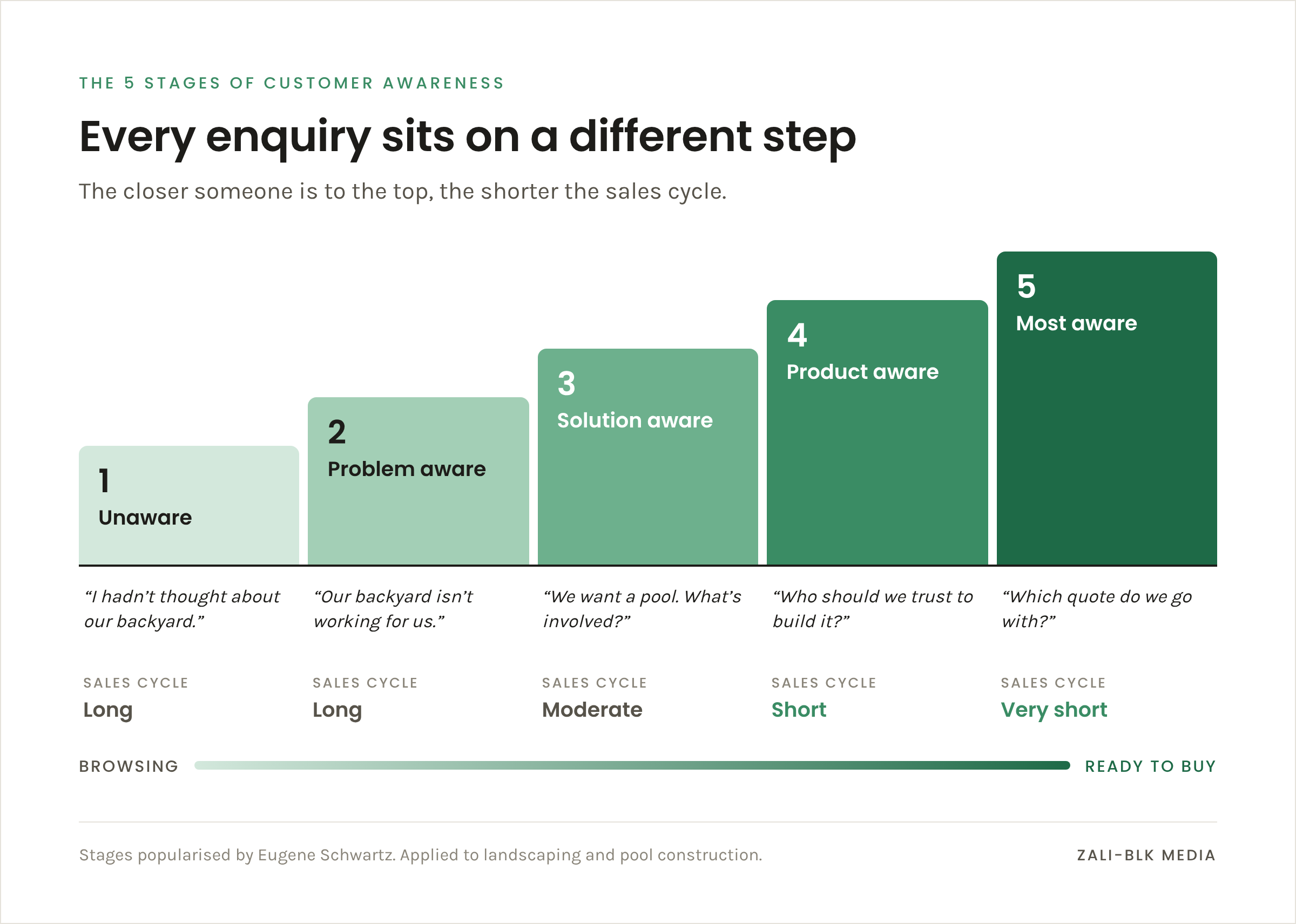
The mistake many businesses make is assuming everyone who sees their advertising is ready to buy.
They're not.
And if your marketing and sales process treats every enquiry the same way, you're likely leaving opportunities on the table.
1. Unaware: They Haven't Realised They Have a Problem Yet
At this stage, someone isn't actively looking for a landscaping or pool construction company.
They might not have considered renovating their backyard, installing a pool or redesigning their outdoor living space.
They simply haven't recognised a reason to take action.
Real-world landscaping example
Imagine a homeowner who has a large, underutilised backyard.
They've lived in the property for several years. The lawn is tired, the garden is overgrown and the outdoor area isn't particularly functional.
But they've never seriously considered doing anything about it.
They aren't searching Google for landscaping companies because they don't yet see landscaping as something they need.
However, they might stop scrolling when they see a beautifully completed outdoor transformation on Facebook or Instagram.
The project catches their attention. They start imagining what their own backyard could look like.
For the first time, they're considering the possibility of doing something similar.
What marketing works at this stage?
This is where interruption-based marketing, such as Meta advertising, can be particularly useful.
Rather than waiting for someone to search for a service, you're putting your business and completed projects in front of people who may eventually become customers.
Good examples include:
- Before-and-after landscaping transformations.
- High-end outdoor entertaining areas.
- Swimming pool and landscaping combinations.
- Beautifully designed gardens and outdoor spaces.
- Videos showing the transformation from an empty backyard to a completed project.
The objective isn't necessarily to generate an immediate enquiry.
It's to create interest and help someone recognise what's possible.
Sales cycle: Generally longer. These people may need considerable time before they're ready to engage a contractor.
2. Problem Aware: They Know Something Needs to Change
At this stage, the homeowner has recognised a problem.
They know their backyard isn't working for them, but they might not know exactly what the solution looks like.
Real-world landscaping example
A family has a sloping backyard that's difficult to use.
The children don't have anywhere to play, there's no suitable entertaining area and the existing garden requires too much maintenance.
They know something needs to change.
They might start researching ideas for sloping backyards, retaining walls, outdoor entertaining areas or low-maintenance gardens.
They're becoming more interested in solving the problem, but they haven't necessarily decided what they need or who they should hire.
What marketing works at this stage?
Meta advertising can work particularly well here.
You can introduce people to ideas and possibilities they might not have considered.
For example:
- How to make better use of a sloping backyard.
- Ways to create more usable outdoor entertaining space.
- Ideas for low-maintenance landscaping.
- How to transform an unusable backyard.
- Common problems with poorly designed outdoor spaces.
You can also use Google Ads to capture people searching for specific problems.
For example:
- Sloping backyard landscaping ideas.
- Retaining wall solutions.
- Backyard drainage problems.
- Low-maintenance garden solutions.
However, there's an important distinction.
Someone searching for ideas is generally less commercially ready than someone searching for a contractor to complete the work.
Sales cycle: Usually longer than someone actively searching for a contractor. They still need to understand their options and decide what they want.
3. Solution Aware: They Know What They Want to Do
Now we're getting closer to someone who's ready to spend money.
They've identified their problem and started researching potential solutions.
They might have decided they want a swimming pool, a new outdoor entertaining area or a complete backyard transformation.
They're now trying to understand what's involved, what it costs and which type of contractor they need.
Real-world pool building example
A homeowner has decided they want a swimming pool.
They've been looking at different pool designs, comparing concrete and fibreglass pools, researching landscaping options and trying to understand the costs involved.
They might be searching for:
- Concrete swimming pool costs.
- Modern swimming pool designs.
- Swimming pool and landscaping packages.
- Pool installation process.
- Backyard pool design ideas.
They're no longer just admiring beautiful backyards.
They're actively researching ways to make their own project happen.
What marketing works at this stage?
Both Google and Meta can play an important role.
On Google, you can target people searching for specific solutions and services.
On Meta, you can continue educating potential customers through project showcases, educational content, testimonials and retargeting.
For example, someone who previously watched your pool transformation video might now see an advertisement explaining the benefits of a complete pool and landscaping package.
The important thing is that your messaging needs to move beyond simply showing attractive projects.
You need to help people understand why your approach, experience and service are worth considering.
Sales cycle: Moderate. They're actively researching, but may still need time to compare options, understand pricing and make decisions.
4. Product Aware: They're Comparing Businesses and Contractors
This is where potential customers become significantly more commercially valuable.
They know what they want, understand the type of service they need and are now comparing businesses that can deliver it.
They might have a rough budget, a preferred timeframe and a reasonably clear idea of what their finished project should look like.
Now they're looking for someone they can trust to do the work.
Real-world landscaping example
A homeowner wants to spend $120,000 transforming their backyard.
They've already decided they want new paving, retaining walls, garden beds, an outdoor entertaining area and improved drainage.
They've started contacting landscaping companies.
They're searching for:
- Landscaping contractors near me.
- Landscape construction companies.
- Backyard landscaping contractors.
- Landscaping companies in Brisbane.
- Landscaping design and construction.
They're comparing completed projects, reading reviews, looking at qualifications and requesting quotes.
They aren't just looking for inspiration anymore.
They're looking for a contractor.
What marketing works at this stage?
This is where Google Search Ads become particularly valuable.
You're targeting people who are actively searching for the services you provide.
Rather than interrupting someone while they're scrolling through social media, you're appearing when they're actively looking for a landscaping or pool construction company.
For example, a Google Ads campaign targeting:
- Landscape construction companies.
- Pool builders in Brisbane.
- Swimming pool construction.
- Landscaping contractors.
- Backyard renovation companies.
These searches generally indicate stronger commercial intent than someone casually browsing landscaping inspiration.
Your landing page should reinforce that intent.
Show completed projects, explain your process, establish credibility and make it easy for someone to enquire.
Sales cycle: Often shorter. These customers have already done much of the research and are actively looking to engage a contractor.
5. Most Aware: They're Ready to Make a Decision
At this stage, the customer knows what they want, understands the service and may already know which businesses they're considering.
They're close to making a decision.
They might have spoken to your team, reviewed your portfolio, received a proposal or even requested a few final details.
They just need enough confidence to move forward.
Real-world pool building example
A homeowner has already spoken to three pool builders.
They've received two proposals and are waiting on your final quote.
They like your previous projects, have seen your customer reviews and feel comfortable with your experience.
They're now comparing the final details.
Price, communication, availability, confidence and the overall experience could determine who wins the project.
What marketing works at this stage?
Your marketing needs to reinforce trust and make it easy for people to take the next step.
This could include:
- Customer testimonials.
- Detailed project case studies.
- Reviews and reputation.
- Clear explanations of your process.
- Follow-up emails and messages.
- Personal contact from your sales team.
At this stage, the biggest mistake is making it difficult for someone to move forward.
If someone has already requested a proposal, don't leave them wondering what happens next.
Follow up, answer their questions and make the next step clear.
Sales cycle: Potentially very short. These customers are already close to making a purchasing decision.
Google Ads vs Meta Ads: Why the Sales Cycle Can Be So Different
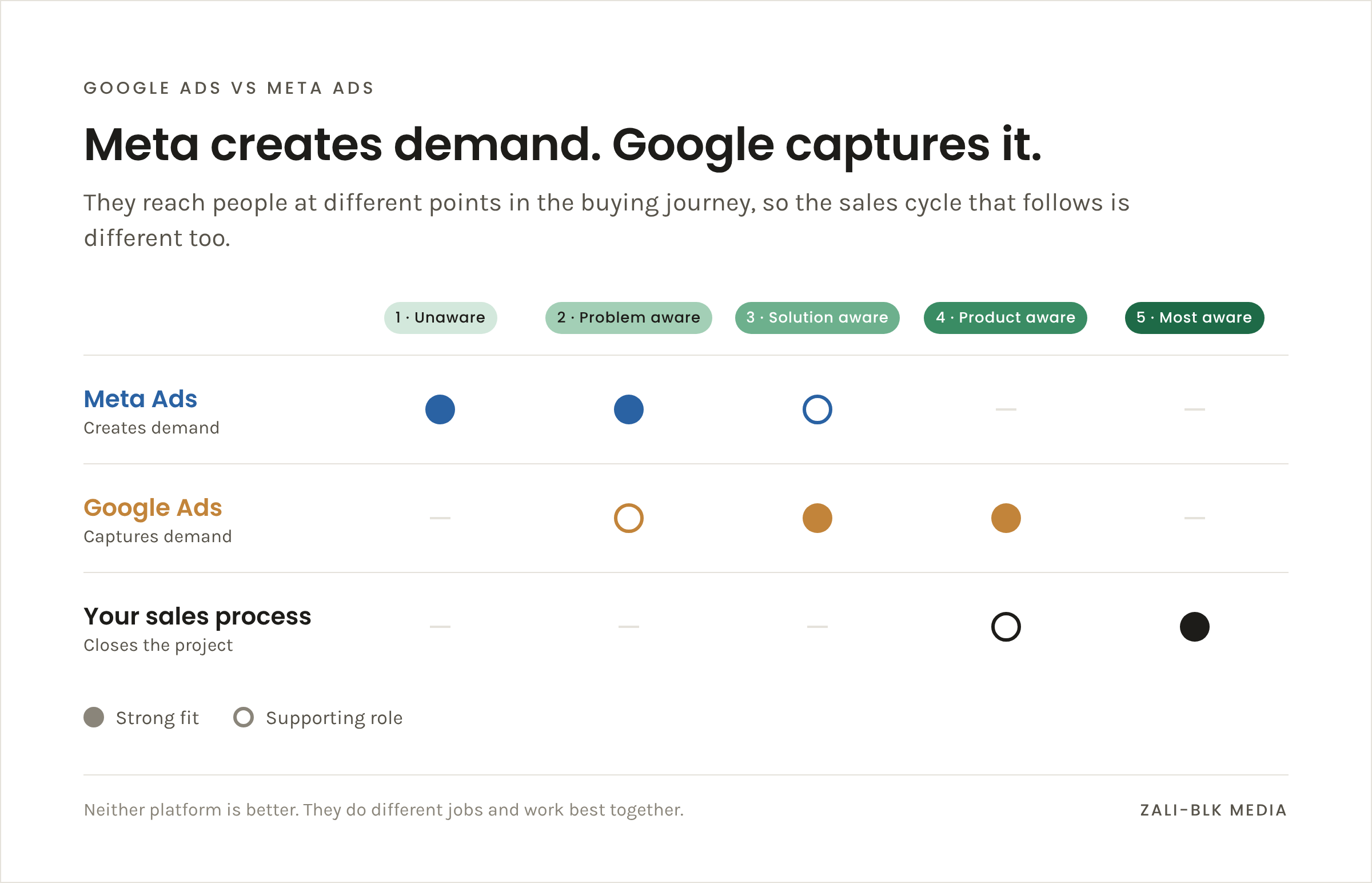
Understanding the five stages of customer awareness makes it much easier to understand why Google Ads and Meta Ads can produce very different sales outcomes.
Both platforms can generate enquiries for landscaping and pool construction businesses.
But they don't necessarily reach people at the same point in their buying journey.
Google Ads: Capturing Existing Demand
Google Search Ads allow you to target people based on what they're actively searching for.
This is important because someone's search query can tell you a lot about their intentions.
Consider these three searches:
Search 1: "Backyard landscaping ideas"
This person is probably researching possibilities. They may not be ready to hire anyone.
Search 2: "How much does backyard landscaping cost?"
This person is considering a project and trying to understand the financial commitment.
Search 3: "Landscaping contractors Brisbane"
This person is actively looking for a business to complete the work.
All three searches relate to landscaping, but they represent very different levels of buying intent.
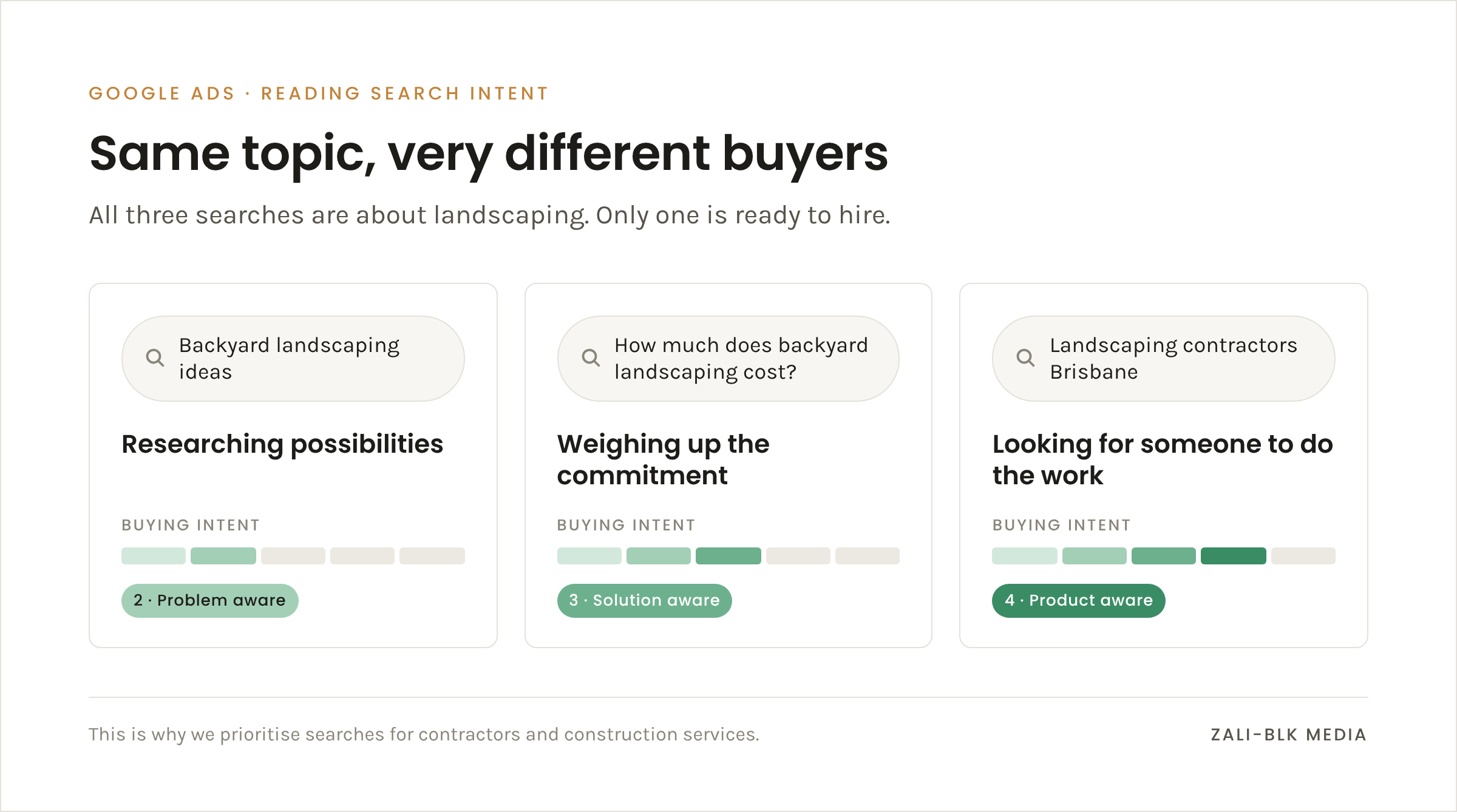
When we build Google Ads campaigns, we focus heavily on identifying and targeting commercially relevant searches.
For established landscaping and pool construction businesses, that generally means prioritising people looking for contractors, construction services and specific project solutions.
The benefit is that we're capturing existing demand rather than relying entirely on creating it.
This can result in shorter sales cycles because the customer has often already recognised their need, researched their options and decided they're ready to engage someone.
Of course, not every Google enquiry is ready to buy immediately. Some people are still comparing prices, researching contractors or planning projects for several months away.
But the search intent gives us a much stronger indication of where they are in their buying journey.
Meta Ads: Creating Demand and Building Interest
Meta advertising works differently.
When someone is scrolling through Facebook or Instagram, they're generally not looking for a landscaping or pool construction company.
They're looking at photos, watching videos, catching up with friends or consuming content.
Your advertisement interrupts that activity.
You might show them a beautiful backyard transformation or a swimming pool that makes them reconsider their own outdoor space.
They might be interested enough to enquire, but that doesn't necessarily mean they're ready to spend $100,000 on a project.
They may still need to:
- Understand what they actually want.
- Research different design options.
- Establish a realistic budget.
- Discuss the project with their partner.
- Compare different contractors.
- Work out when they're ready to proceed.
This doesn't mean Meta leads are poor-quality leads.
It means they can require a different sales approach.
You're often dealing with people who need more education, more communication and more time before they're ready to make a purchasing decision.
That's why it's important not to judge an advertising campaign purely by the number of enquiries it generates or the cost per lead.
You also need to consider how much work is required to turn those enquiries into paying customers.
Why Your Sales Process Matters Just as Much as Your Advertising
Here's where many landscaping and pool construction businesses run into trouble.
They invest in advertising, enquiries start coming through, and suddenly they're expected to manage an entirely new workload.
They're already running a business.
They're managing employees, organising materials, visiting job sites, dealing with suppliers, preparing quotes and keeping existing customers happy.
Now they're also expected to respond to every new enquiry, make phone calls, send text messages, write follow-up emails and remember who needs contacting.
It's a lot to manage.
And when you're busy running the business, sales follow-up is often one of the first things to fall behind.
The problem is that potential customers don't stop considering their options just because you're busy.
If you don't follow up, another contractor might.
Not every enquiry should receive the same follow-up process
Remember the five stages of customer awareness?
Someone searching Google for a landscaping contractor might be ready to book a consultation.
Someone who enquired after seeing a backyard transformation on Facebook might still be researching ideas.
Treating both people exactly the same way isn't necessarily going to produce the best results.
Your sales process needs to account for these differences.
For example:
A high-intent Google enquiry
- Respond quickly.
- Make contact by phone.
- Understand their project requirements.
- Establish their budget and timeframe.
- Arrange a consultation or site visit.
- Follow up with a clear next step.
A less-aware Meta enquiry
- Respond promptly.
- Understand what attracted their interest.
- Establish whether they have an actual project in mind.
- Provide useful information and relevant examples.
- Follow up over time.
- Keep your business in consideration until they're ready.
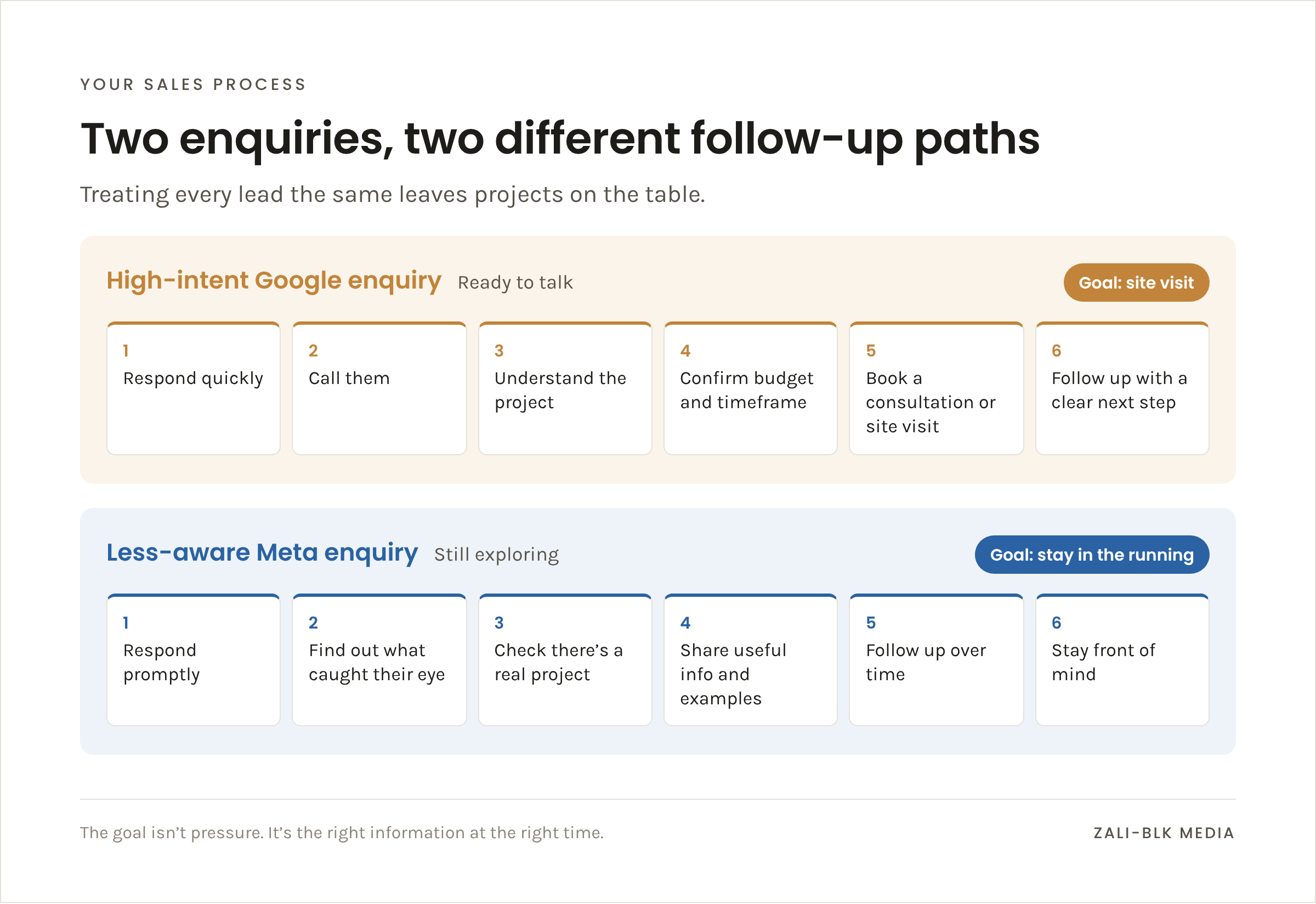
The objective isn't to pressure someone into buying before they're ready.
It's to provide the right information and maintain communication until they're comfortable moving forward.
Building a Sales System That Does the Heavy Lifting
You don't necessarily need to spend your evenings manually following up with every potential customer.
You need a system that helps you manage the process.
This is where automated workflows, customer relationship management (CRM) software and structured sales processes become incredibly valuable.
Instead of relying on your memory or a collection of unanswered emails, you can build a process that automatically handles some of the repetitive work.
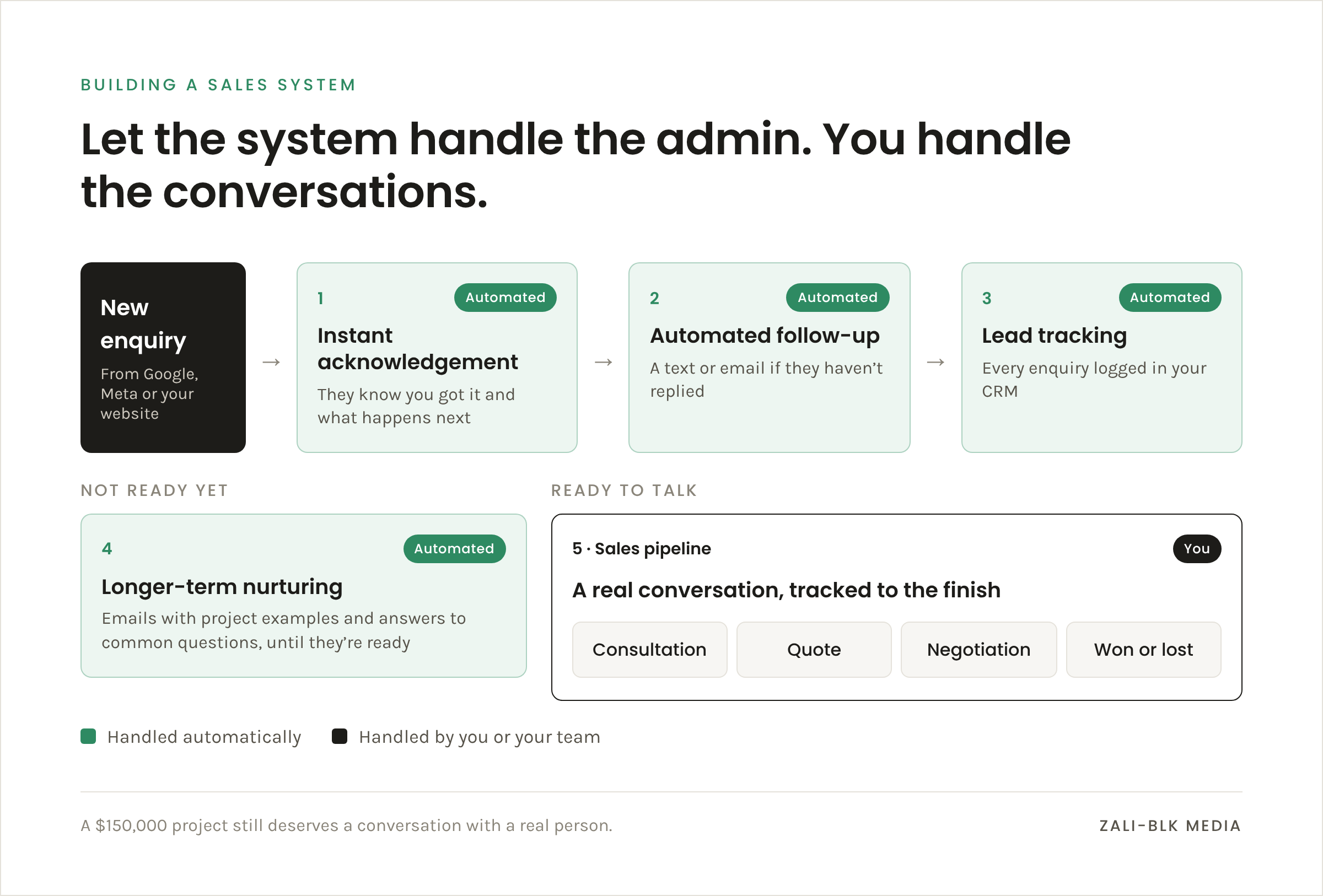
For example:
1. Instant enquiry acknowledgement
When someone submits an enquiry, they automatically receive a confirmation message letting them know their details have been received and what happens next.
2. Automated follow-up
If someone hasn't responded to your initial contact, a follow-up text or email can be sent automatically.
3. Lead tracking
Every enquiry is recorded in your CRM, allowing you to see who has been contacted, who needs following up and which opportunities are still active.
4. Longer-term nurturing
For customers who aren't ready to proceed immediately, automated email sequences can provide useful information, project examples and answers to common questions over time.
5. Sales pipeline management
You can track enquiries from their initial contact through to consultation, quoting, negotiation and ultimately winning or losing the project.
The important thing is that these systems don't replace personal communication.
A $150,000 landscaping project still deserves a conversation with a real person.
Automation simply makes sure the repetitive administrative work doesn't consume all your time or allow good opportunities to slip through the cracks.
It gives you more time to focus on the conversations that actually move projects forward.
The Real Lesson: Meet Customers Where They Are, Not Where You Want Them to Be
One of the biggest mistakes businesses make with marketing is expecting every potential customer to be ready to buy.
They aren't.
Some people are discovering what's possible. Others are researching solutions. Some are comparing contractors, while others are ready to sign a proposal.
Your marketing needs to recognise these differences.
Your advertising needs to reach the right people, with the right message, at the right stage of their buying journey.
And your sales process needs to support them from their first interaction through to becoming a paying customer.
Google Ads can help you capture existing demand from people actively searching for your services.
Meta Ads can help introduce your business to new audiences, create interest and build demand over a longer period.
Neither approach is inherently better than the other. They serve different purposes and can work together as part of a broader marketing strategy.
But regardless of which platform you use, generating enquiries is only the beginning.
The real opportunity is building a business that can consistently turn those enquiries into profitable projects without relying on you to personally manage every single interaction.
Want more high-intent project enquiries, and a sales process that turns them into signed jobs? Get in touch and let's see if we're a fit.
About the author

Dan De sousa is the founder of Zali-Blk Media, a digital marketing and technology business specialising in the landscaping and pool construction industries.
With a background as an Electronic Technician in the Australian Defence Force and a self-taught software developer, Dan has spent more than five years helping landscaping and pool construction businesses generate better project enquiries and build more effective sales processes.
Having worked closely with businesses across the industry, he understands that generating enquiries is only one part of the equation. Understanding customer behaviour, managing sales opportunities and building systems that support business growth are equally important.
His approach is grounded in practical industry experience, real campaign data and a belief that good marketing should make running a business easier, not more complicated.